
ICSI Treatment in Sector 23A

Introduction
For many couples, the journey to parenthood is filled with a lot of challenges. When male infertility, low sperm count or previous IVF failures stand in the way, the dream of having a baby can feel out of reach, and it's hard to accomplish. This is where Intracytoplasmic sperm injection (ICSI) took place as a saviour for them.
At Crystal Fertility, we specialise in offering ICSI fertility treatment in India with high success rates, affordable costs, and world-class facilities. With the proper treatment and medical and emotional support. We even help couples to take confident steps towards parenthood.
What is Intracytoplasmic Sperm Injection (ICSI)?
You can have a baby without IVF if you use Intracytoplasmic Sperm Injection (ICSI). Eggs and sperm are put in a lab dish and left to fertilise normally during traditional IVF. In ICSI, on the other hand, only one sperm is put into the egg directly. A low number of sperm, slow motility, an abnormal form of the sperm, or azoospermia can make this method less effective in many situations. ICSI ensures that the egg is fertilised, even when there are few healthy sperm present.
In short, ICSI gives couples who are having a hard time getting pregnant because of severe male infertility or repeated IVF failures hope.
Intracytoplasmic Sperm Injection (ICSI) Procedure at Crystal Fertility
Putting sperm straight into an egg is a special way we use at Crystal Fertility to help couples have babies. Our highly skilled doctors perform this operation with great care to give couples the best chance of conceiving
Here's How It Works:
1. Getting the Eggs Ready (Ovarian Stimulation & Egg Retrieval)- To help her ovaries make more eggs than usual, she takes strong medicines that are like vitamins. The eggs are carefully removed from the woman while she sleeps (under light anaesthesia, which feels like a light sleep) when they are ready.
2. Getting the Best Sperm (Sperm Collection & Selection - TESA/PESA) -Using super-strong microscopes (like those in science class but much more powerful), our specialists select the strongest, healthiest sperm. Sometimes they need to get sperm directly from the man's body using tiny procedures called TESA or PESA (basically getting sperm from where they're made).
3. Putting Sperm and Egg Together (Micromanipulation & ICSI Injection) - This is the special part! Our scientists use a needle that is much thinner than a human hair to insert a single sperm directly into an egg in the lab, as if you were to help the sperm get into the egg when it might not be able to do it on its own.
4. Growing the Baby's First Cells (Embryo Development) - The embryos that are growing healthiest are selected by the doctors and gently placed into the woman's uterus, where they hope to develop into a baby.
5. Putting It Back (Embryo Transfer) - An embryo is the very first part of a baby. It is made of an egg that has a sperm inside it. It is kept in a special warm box that helps it grow.
Why This Works: This method is especially effective when the man's sperm aren't functioning properly (either not enough or sperm that don't swim well) or when other methods have failed to help the couple conceive.
What Do These Medical Words Mean?
| Medical Term |
Simple Explanation |
| Embryo |
The very first stage of a baby (just a few cells) |
| Uterus/Womb |
The place inside a woman where babies grow |
| Ovaries |
Parts of a woman's body that make eggs |
| Sperm |
Tiny cells from men needed to make babies |
| Fertilization |
When sperm and egg join together to start making a baby |
How Many Injections for ICSI Treatment?
Many patients want to know how many shots they will need for ICSI.
At Crystal Fertility, we make sure that every couple knows exactly what to expect
- Women may need between 8 and 12 fertility shots over the course of 10 to 12 days during the therapy phases.
- The number of injections you need depends on things like:
- Ovarian reserve / Age of the lady, and a personalised treatment plan made by our reproductive specialists.
These shots are very important for getting the womb ready to make more than one healthy egg, which makes ICSI treatment more likely to work.
Why Choose ICSI at Crystal Fertility?
We at Crystal Fertility know that each couple's journey is different. That's why we offer advanced ICSI fertility treatment that goes beyond normal care and includes all you need.
Here’s why couples trust us as one of the best ICSI fertility clinic options in India:
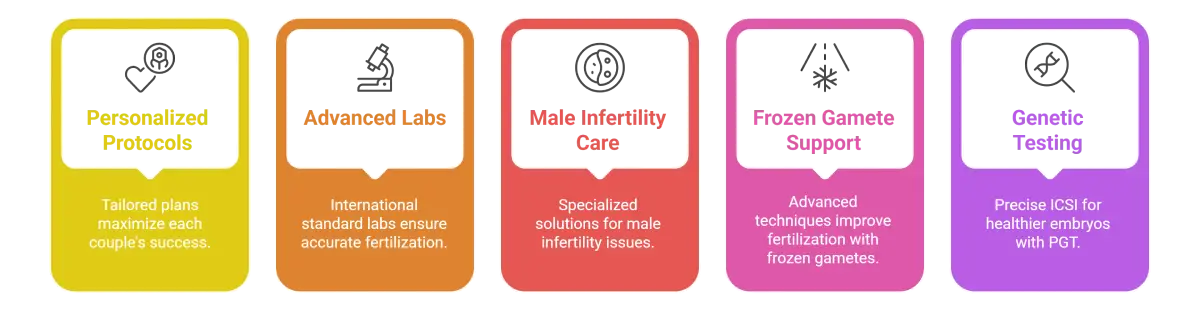
When you choose Crystal Fertility, you select a clinic that uses the latest laboratory equipment and offers caring support, so you know you'll be taken care of every step of the way.
ICSI Success Rates at Crystal Fertility
We are happy to have some of the best ICSI success rates in India at Crystal Fertility.
ICSI is one of the most effective reproductive procedures because it has a 70–80% success rate for conception.
| Age Group |
Fertilization Success |
Pregnancy Rates |
| Under 35 |
70–80% |
60–65% |
| 35 – 40 |
55–65% |
45–50% |
| Above 40 |
40–50% |
30–35% |
We use contemporary embryology labs, cutting-edge technology, and tailored treatment plans, together with caring staff, to provide every couple the best chance of success at Crystal Fertility.
ICSI Treatment Cost at Crystal Fertility
We make our prices fair and easy to understand at Crystal Fertility. There are no hidden fees in our ICSI treatment cost. It includes everything you need for the treatment.
- What is included?
- Talks with doctors
- Hormone shots and fertility drugs
- Sperm collection (semen sample or surgical retrieval, such as TESA or PESA)
- ICSI lab procedure: injecting sperm into the egg and letting the embryo grow.
- Putting the embryo into the uterus
- Emotional and medical help all the time
The cost of ICSI IVF is a little greater than that of standard IVF since it needs more complex lab work. However, it has a better likelihood of fertilization when male infertility is the problem.
We ensure that every couple can afford, understand, and receive excellent treatment at Crystal Fertility.
Comprehensive Support for Every Patient
We're with you all the way at Crystal Fertility. ICSI treatment is more than just medical care; it's also a trip of emotions. That's why we provide:
- Help from experts—clear solutions to all your questions
- Emotional support: help dealing with stress and staying upbeat
- Open Communication—Frank Updates During Your Treatment
- Full Care: Help before, during, and after treatment
On your way to becoming a parent, you're never by yourself. We're here for you.
Begin Your Parenthood Journey with Crystal Fertility
We use ICSI to help couples have babies. Our compassionate doctors utilise the most effective tools and approaches to provide care. We understand this is scary or difficult. Fear not—we'll be with you every step of the way. We're here to support you from your initial visit until the good news.
Contact Crystal Fertility today to begin your parenting adventure.
ICSI Treatment in Sector 23A
Crystal Fertility offers the best ICSI treatment in Sector 23A for couples facing male infertility, with micromanipulation done in-house rather than outsourced. Patients looking for the best ICSI centre in Sector 23A, an ICSI center in Sector 23A they can trust, or the best ICSI doctor in Sector 23A consistently choose our Dwarka clinic for its in-house embryology lab.
How to Choose an ICSI Clinic in Sector 23A
ICSI treatment in Sector 23A looks similar on paper across most clinics, a single sperm is injected directly into a mature egg instead of leaving fertilisation to chance in a dish. But the outcome depends heavily on things that don't show up in a brochure: the embryologist's hands-on experience with the injection itself, the lab's incubation environment, and how carefully sperm is selected before injection when male infertility is severe.
The injection step is performed under a microscope by an embryologist, not the fertility doctor, which surprises some patients who assume the same person managing their treatment also performs this part. What matters is how experienced that embryologist is specifically with ICSI, since the technique requires picking a single, intact sperm and injecting it into the egg without damaging either. A clinic offering ICSI treatment in Sector 23A should be able to tell you, directly, how many ICSI cycles its embryology team handles and what their fertilisation rate typically looks like.
Fertilisation rate is a more useful number to ask about than overall success rate when comparing clinics specifically on ICSI quality, because it isolates the embryology lab's performance from other variables like patient age or uterine factors that affect pregnancy later in the process. Crystal Fertility's ICSI programme openly discusses how fertilisation rates shift with age and sperm quality, rather than quoting a single headline figure that applies to everyone.
When ICSI is actually necessary, and when it isn't
ICSI treatment in Sector 23A is sometimes recommended by default even for cases where standard IVF, letting sperm fertilise the egg naturally in the lab, would work just as well. ICSI is clearly the right call for severe male factor infertility, very low sperm count or motility, prior fertilisation failure with standard IVF, or when using surgically retrieved sperm. Outside of those situations, the evidence that ICSI improves outcomes over conventional IVF is less clear-cut, and a clinic recommending it routinely regardless of sperm parameters is worth questioning on why. Dr. Nidhi Sharma reviews the semen analysis specifically before recommending ICSI over standard IVF, rather than defaulting to it for every cycle.
Understanding ICSI cost in Sector 23A
ICSI cost in Sector 23A is typically quoted as an addition to the base IVF cycle cost, since ICSI replaces only the fertilisation step within an otherwise standard IVF process, egg retrieval, embryo culture, and transfer still happen the same way. What varies between clinics is whether that additional ICSI fee is the only extra cost, or whether it comes bundled with assumptions about additional procedures like assisted hatching or PGT testing that aren't always necessary. Getting a written, itemised estimate before starting treatment, one that separates the base IVF cost from the ICSI-specific fee and any optional add-ons, makes it far easier to compare one clinic's ICSI cost in Sector 23A against another's on equal terms.
Support beyond the lab
Choosing an ICSI clinic in Sector 23A isn't only about embryology. Because ICSI is most often used for male infertility, a clinic that evaluates and, where possible, treats the underlying male fertility issue, rather than treating ICSI purely as a workaround, tends to serve patients better long-term. Crystal Fertility's approach includes a full male fertility evaluation alongside ICSI planning, since factors like varicocele or hormonal imbalance sometimes respond to treatment that improves sperm parameters for future cycles too, not just the current one.
What happens if sperm quality is severe enough that even ICSI is in question
In a small number of cases, sperm count or motility is low enough that even collecting a usable sample through ejaculation isn't possible, and the conversation moves to surgical sperm retrieval, procedures like TESA or PESA that extract sperm directly from the testicle or epididymis for use in ICSI. This is a more involved path than standard ICSI treatment in Sector 23A, and it's worth asking any clinic you're considering whether this capability exists in-house or requires referring you elsewhere, since coordinating a surgical retrieval with the egg retrieval timing of your partner's cycle is logistically tighter, and considerably less stressful, when both procedures are handled under one roof by one coordinated team.
It's also worth asking what happens to any embryos that don't get used in the first transfer. A clinic doing ICSI well will freeze remaining good-quality embryos rather than letting them go to waste, giving you a head start on a future FET cycle without repeating the stimulation and retrieval process. Crystal Fertility discusses this embryo-freezing plan as part of the initial ICSI consultation, not as an afterthought once the embryo transfer is already done, so patients know from the outset how many attempts their current egg and sperm collection could realistically support.
FAQ (Frequently Asked Questions):
Helpful Resources

Medically Reviewed by
Dr. Nidhi Sharma, MBBS, DGO, DNB
Dr. Nidhi Sharma is a fertility specialist with an MBBS, a DGO in Obstetrics & Gynaecology, and a DNB, bringing over 20 years of experience in reproductive medicine. She leads the IVF, ICSI, and fertility preservation programmes at Crystal Fertility & IVF Center in Dwarka, New Delhi.