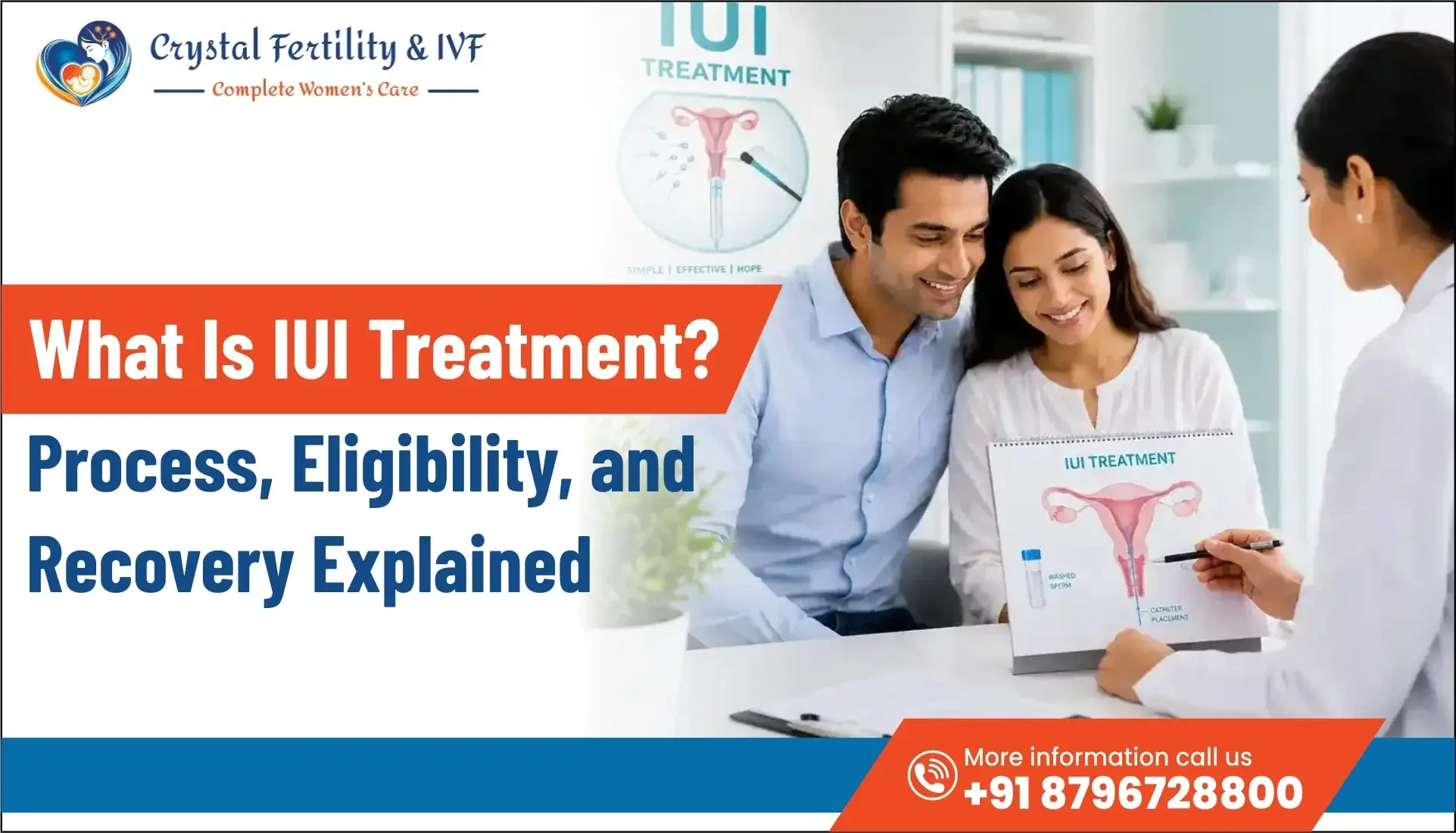
What exactly is the IUI procedure? Intrauterine Insemination (IUI) is a fertility treatment that involves specially prepared fertilized sperm being inserted directly into the uterus at the time of ovulation to increase the chance of fertilization. At Crystal Fertility, IUI may be suggested for couples who have particular fertility problems in cases where natural conception has proven difficult. It's a fairly straightforward, minimally invasive procedure that usually needs less treatment than IVF. Knowing the IUI procedure, eligibility criteria, and recovery may help patients approach the procedure with realistic expectations and increased confidence.
What Is IUI Treatment?
IUI, also known as Intrauterine Insemination, is a method of assisted reproduction created to bring healthy and mobile sperm closer to the egg. In a normal pregnancy, sperm must pass through the vagina, the cervix, and the uterus before getting to the fallopian tubes, in which fertilization occurs. In IUI treatment, the prepared sperm is injected directly into the uterus using a small catheter. The process does not require fertilization outside the body. The egg and sperm connect naturally in the reproductive tract. IUI can be carried out in conjunction with a woman's natural ovulation cycle, or with fertility medication based on the person's fertility issues.
Who Is Eligible for IUI Treatment?
IUI is not for everyone. A fertility specialist generally suggests it after examining the couple's history, fertility tests, and the function of the fallopian tubes, ovarian health, and sperm quality.
IUI might be a candidate as a result of:
- Unexplained infertility
- Infertility caused by males
- Problems with ovulation
- Cervical-factor infertility
- Donor sperm is used to make
- Problems with intercourse
- There are some cases of endometriosis
- Couples who need assisted conception, but do not need IVF
At least one fallopian tube must be functional and open, since fertilization is still occurring naturally in the body. Women who have severely diminished reserves of ovarian tissue or significant tubal disease, advanced endometriosis, or serious male-factor infertility issues may be advised to consider IVF treatment or a different option instead.
How Does IUI Treatment Work?
The IUI procedure is fairly simple.However, the timing of your procedure is crucial.
Step 1: Fertility Evaluation
Before beginning treatment,the doctor will evaluate each partner if necessary.
Tests can consist of:
- Ultrasound exam
- Tests for hormones
- Reserve assessment for Ovarians
- Semen analysis
- Evaluation of the fallopian tube
- Reproductive and medical background
The results will help determine if IUI is appropriate, and whether it is necessary to undergo additional treatments.
Step 2: Monitoring Ovulation
IUI is best timed to coincide with the time of ovulation.
Certain women undergo IUI in their natural cycle. Others are treated with medication to increase the ovulation cycle and promote the growth of mature follicles.
Ultrasounds help fertility professionals identify when follicles are at their peak.
Step 3: Sperm Collection and Preparation
A sample of sperm is normally taken at the time of the insemination.
The lab uses the specimen to sort healthy, motile sperm from seminal fluid, and less-motile and non-motile sperm.
This process produces an extremely concentrated product that is ideal for insemination.
Step 4: Insemination
The sperm prepared for implantation is introduced into the uterus using the catheter, which is thin and flexible.
The procedure usually takes just an hour and doesn't need surgery.
Most patients feel no discomfort, though slight cramping may occur.
Step 5: After IUI
Following the insemination procedure, the patient can return home and resume normal tasks according to the physician's instructions.
The pregnancy test is generally done two weeks after the insemination.
Is IUI Treatment Painful?
IUI is generally regarded as an minimally invasive and easily tolerated procedure that is well-tolerated and minimally invasive.
Patients may have:
- Mild cramps resembling menstrual cramps
- The pelvic area may be uncomfortable temporarily.
- Light Spot
- A sensation of pressure during catheterization
The symptoms typically resolve in a short time. If abdominal pain is severe and bleeding is heavy, dizziness, fever, or any other symptoms that are concerning develop, the patient must contact the fertility specialist immediately. IUI With or Without Fertility Medication IUI can be performed during a natural cycle or with ovulation-stimulating medication.
Natural-Cycle IUI
When a cycle is natural, the doctor observes the woman's natural ovulation and schedules the insemination accordingly.
This option is possible when ovulation has been regular and fertile factors appear favorable.
Medicated IUI
Fertility drugs can be utilized to stimulate the growth and maturation of follicles.
Monitoring is crucial because an excess ovarian response can increase the chance of having multiple pregnancies and, in the case of certain medications and treatments, can cause ovarian hyperstimulation.
The decision between natural and medicated IUI is based on the diagnosis of the patient and the history of treatment.
What Determines IUI Success?
Patients frequently inquire whether they have a success rate with IUI; however, there isn't a single success rate that applies to all patients.
The most important factors are:
Age
The age of women is a significant indicator of the results of fertility treatments because the quantity of eggs and their quality tend to decrease with age.
Egg and Ovarian Health
A healthy ovarian reserve, as well as proper follicular development, could lead to more effective treatment outcomes.
Sperm Quality
Sperm concentration, motility, and overall quality could affect the possibility of fertilization.
Fallopian Tube Health
A functioning fallopian tube is typically required because fertilization takes place within the body.
Cause of Infertility
IUI might be better suited to certain diagnoses in comparison to other diagnoses. Severe tuberculosis or male-factor infertility could need IVF instead.
Timing of Ovulation
Accurate timing is essential. Monitoring hormonal levels and ultrasound can help determine the ideal timing for insemination.
What Is IUI Recovery Like?
One of the benefits that comes with IUI is the quick recovery time. Most patients don't require bed rest or a long recovery time after the procedure. The normal daily routine can be resumed following the advice of a fertility specialist. Certain patients may experience slight cramping or spotting that lasts for an indefinite period. There is usually no surgical cut since the sperm enters via the cervix with an instrument. However, patients must follow any specific guidelines regarding exercise, medications, relationships, and other actions given by their physician.
What Happens After IUI?
The time between IUI and the pregnancy test may be emotionally difficult.
Patients may experience symptoms like:
- Mild cramping
- Tenderness in the breast
- Bloating
- Fatigue
- Light spot
These symptoms don't necessarily mean that you are pregnant. They can also be a result of hormonal medication. An ultrasound test for pregnancy is usually conducted around 14 days after IUI. If you test too early, it could result in an incorrect result.
What Are the Risks of IUI?
IUI is generally regarded as an infertility procedure with low risk. However, risks could be based in part on the fertility medications that are being used.
Risks that could be posed could include:
- Mild cramping
- Light Spot
- The infection, though rare
- Multiple pregnancy, particularly when ovulation-stimulating medications are used
- Ovarian hyperstimulation syndrome is a common occurrence in medically prescribed cycles.
Monitoring of treatment is essential to reduce risk.
How Many IUI Cycles May Be Needed?
Some couples can conceive in their initial IUI cycle, whereas others require several attempts.
The correct number of cycles to run depends on:
- Age
- Diagnostics of fertility
- Reserve Ovarian
- Sperm quality
- Response to treatment before the initial
If pregnancy is not evident after a series of carefully scheduled IUI cycles, the fertility doctor may review the situation and determine whether IVF or other treatments are more likely to be successful.
IUI vs IVF: What Is the Difference?
The main difference between IVF and IUI is where fertilization occurs.
IUI: The sperm that is prepared for IUI is put into the uterus, and fertilization takes place naturally within the body.
IVF: The eggs can be retrieved and fertilized using sperm in a laboratory. The resultant embryo is placed in the uterus.
IUI generally is simpler and less invasive. It is also cheaper as compared to IVF. But IVF might be suitable when infertility is due to blocked fallopian tubes or severe male-factor infertility, a significant reduction in ovarian reserve, or a series of ineffective IUI cycles.
Conclusion
What, then, is IUI treatment? It is a minimally invasive fertility treatment that injects specially prepared fertilized sperm directly into the uterus at the time of ovulation. This increases the chances of fertilization. It is a good option for couples who have undiagnosed infertility, mild male factor infertility, problems with ovulation, cervical issues, or other specific reproductive issues. The procedure involves fertility testing, including ovulation monitoring, ng as well as sperm preparation, insemination, and a pregnancy test. Recovery can be rapid, with the majority of patients being able to resume regular activities within a few days of the procedure. The process is not without risk; however, IUI results are contingent on things like age and ovarian reserve, sperm quality, health of the tubal diagnostics, and precise timing of ovulation. At Crystal Fertility, the treatment is based on the specific medical situations rather than following a standard protocol. A thorough consultation will help determine if IUI is the right choice or if another fertility treatment could provide an increased chance of pregnancy.
FAQs
1. Is IUI identical to IVF?
No. IUI injects sperm prepared for IUI into the uterus. IVF involves removing eggs and fertilizing them inside a lab and then placing an embryo into the uterus.
2. How long will an IUI procedure last?
The process itself usually is only a couple of minutes. But preparation and monitoring take place before the insemination.
3. Do I have the right to return to work after IUI?
Most patients can return to their normal routine within a few days of IUI. The fertility specialist you consult with may give specific guidelines based on your treatment.
4. When do I do an exam for pregnancy following IUI?
The pregnancy test is usually carried out around 14 days following the insemination procedure, as recommended by your fertility doctor.
5. Is IUI appropriate for all?
No. IUI is best suited for specific fertility problems. An extensive evaluation is required before starting treatment.
Helpful Resources