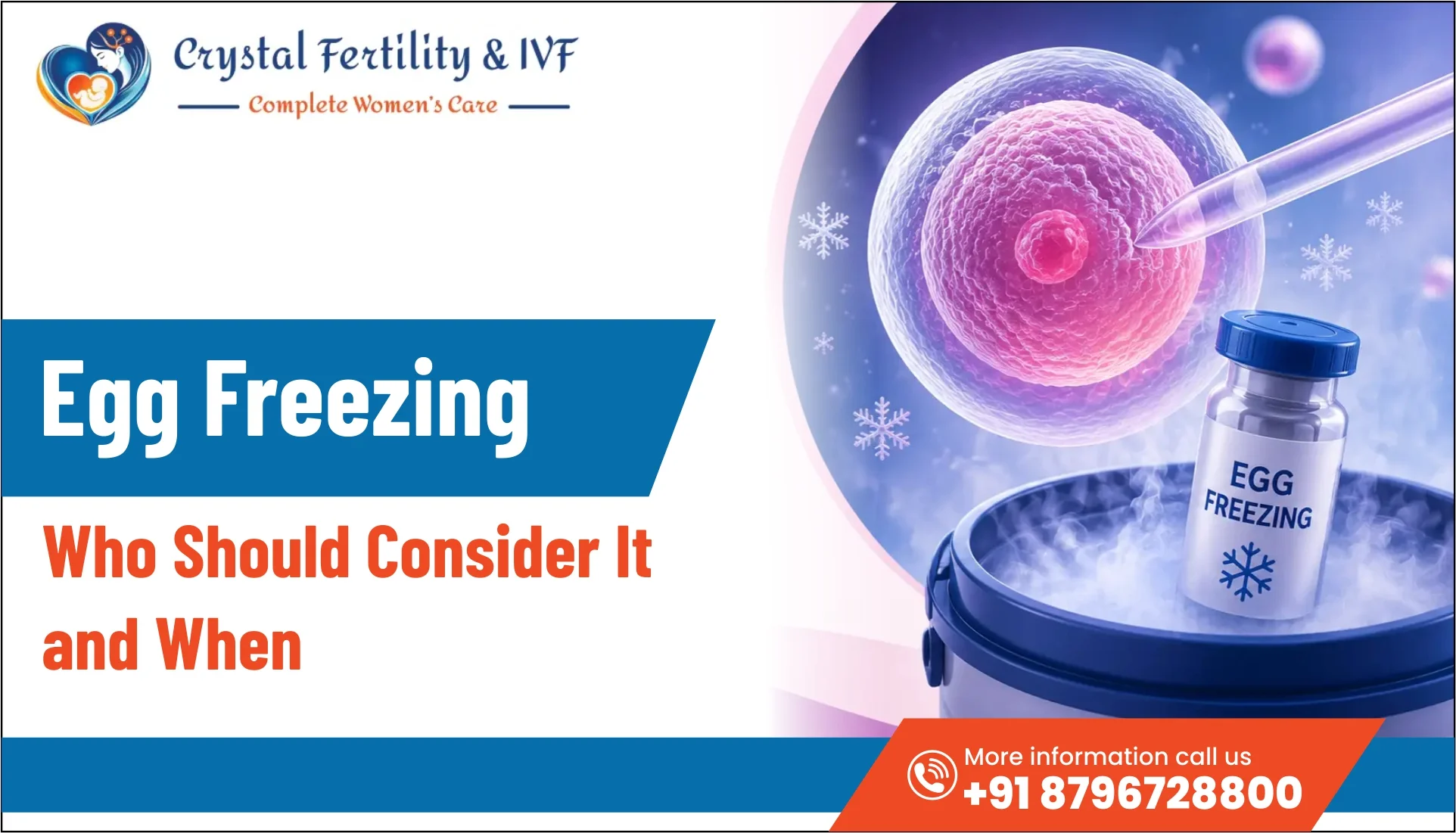
For women looking to preserve their fertility for a future family, egg freezing in Delhi is worth discussing with a fertility professional. At Crystal Fertility & IVF Center, egg freezing can be considered by women who wish to delay pregnancy for medical, professional, or personal reproductive reasons. The method, also known as oocyte cryopreservation, involves retrieving mature eggs from the ovaries, then freezing and storing them for future use. Freezing eggs does not guarantee a future pregnancy — the age at which eggs are frozen, ovarian reserve, and overall reproductive health all affect the eventual outcome.
What Is Egg Freezing?
Egg freezing is a fertility technique in which a woman's mature eggs are retrieved from the ovaries and stored at very low temperatures for potential future use.
Unlike embryo freezing, egg freezing doesn't require fertilizing the eggs with sperm before preservation, giving women the option to preserve eggs before deciding when they want to have children.
The process is often called oocyte cryopreservation. Modern fertility clinics generally use vitrification, a rapid-freezing method that reduces the formation of damaging ice crystals during freezing.
When a woman is ready to try for pregnancy, the frozen eggs can be thawed. Suitable eggs are then fertilized with sperm, typically through intracytoplasmic sperm injection (ICSI), to create embryos, which can then be transferred into the uterus.
Why Do Women Consider Egg Freezing?
There's no single reason women choose to freeze their eggs — fertility decisions are personal, and circumstances differ from woman to woman. The most common reasons include:
Delaying Pregnancy for Personal Reasons
Women may not be ready to have children due to education, career goals, relationship status, financial considerations, or other personal factors. Egg freezing lets you preserve eggs for later while giving yourself time to plan ahead.
Medical Treatment That May Affect Fertility
Certain cancer treatments, including chemotherapy and radiation therapy, can affect fertility. Depending on the diagnosis and treatment plan, fertility preservation can be discussed before treatment begins. Other health conditions or surgeries affecting the ovaries can also impact fertility. In these situations, consulting a fertility specialist as early as possible helps ensure fertility preservation doesn't delay necessary medical treatment.
Reduced Ovarian Reserve
Some women have a lower ovarian reserve than typically expected for their age. Tests like AMH or antral follicle count can offer information about ovarian reserve, though they can't reliably predict whether a future pregnancy will occur. A fertility expert may suggest egg freezing if there's concern the number of eggs could decline significantly over time.
What Is the Best Age for Egg Freezing?
One of the most common questions women ask is about the ideal age to freeze eggs.
In general, a younger age at egg retrieval is linked to better egg quality and a higher chance that each egg will eventually lead to a successful pregnancy, since egg quantity and quality tend to decline with age, especially from the mid-to-late 30s onward.
There's no single age at which every woman should freeze her eggs. Women considering elective fertility preservation are typically advised to think about it in their late 20s or early 30s, rather than waiting until fertility has already declined significantly.
Age is just one factor — ovarian reserve, medical history, prior ovarian surgery, family history of early menopause, and personal fertility goals all need to be considered. Freezing eggs doesn't stop the biological aging of eggs already in storage; the eggs retain the characteristics of the age at which they were retrieved.
Understanding the Egg Freezing Process
Egg freezing generally happens in several stages, and the exact process varies based on ovarian reserve, age, medical history, and the fertility specialist's assessment.
Step 1: Initial Fertility Assessment
The process usually begins with a consultation and fertility assessment. Your doctor may review reproductive and medical history, menstrual cycle, previous pregnancies, prior ovarian surgery, medications, family history, and ovarian reserve.
This typically includes blood tests and an ultrasound examination. AMH testing helps determine ovarian reserve, and ultrasound helps assess the ovaries and count antral follicles — together, these help the fertility team understand how the ovaries are likely to respond to stimulation.
Step 2: Ovarian Stimulation
In a typical menstrual cycle, usually only one egg matures. For egg freezing, fertility medication is used to stimulate the ovaries so multiple follicles can develop in a single cycle.
The patient takes injectable medication according to a prescribed schedule, while ultrasounds and hormone tests track follicular growth. The doctor adjusts treatment as needed and determines when the eggs are ready for retrieval.
Step 3: Trigger Injection
Once the follicles have developed sufficiently, the doctor administers a trigger medication that allows the eggs to complete their final stage of maturation before release. Egg retrieval is scheduled within a specific window after the trigger injection.
Step 4: Egg Retrieval
Egg retrieval is generally performed as a minimally invasive, ultrasound-guided procedure. A needle is passed through the vaginal wall to the ovarian follicles to collect the follicular fluid containing the eggs.
The procedure typically takes a relatively short time, with anesthesia or sedation administered according to clinic protocol and the patient's needs. The embryology lab then examines the collected fluid to identify mature eggs.
Step 5: Vitrification and Storage
Mature eggs are prepared for freezing using vitrification, a rapid cryopreservation technique, and stored under specially controlled cryogenic conditions until needed.
Not every egg retrieved will be mature enough or suitable for freezing, so the number of eggs collected and the number successfully frozen can differ.
How Many Eggs Should Be Frozen?
There's no single number that guarantees a future pregnancy. How many eggs a woman is advised to freeze depends on factors such as:
- Age
- Ovarian reserve
- Response to stimulation
- Number of mature eggs retrieved
- Future family-building goals
- Previous fertility treatment
Younger women may retrieve a different number of mature eggs than those freezing eggs later in life, and sometimes more than one stimulation cycle is needed to reach the desired number. A fertility expert should set realistic expectations rather than promise that a specific number of eggs guarantees a baby.
What Happens When You Want to Use Frozen Eggs?
When a woman chooses to use her frozen eggs, they're carefully thawed in the lab. Not every egg survives the thawing process. Eggs that do survive can be fertilized with sperm, typically using ICSI, since direct sperm injection can help address some of the added challenges of fertilizing a previously frozen egg.
The resulting embryos are monitored as they develop, and a suitable embryo can be transferred into the uterus at an appropriate point in the cycle, with pregnancy confirmed through standard testing afterward.
Who Should Consider Egg Freezing?
Egg freezing may be worth considering if you:
- Want to delay pregnancy for personal reasons
- Aren't ready to start a family yet
- Expect to delay childbearing for several years
- Are undergoing medical treatment that could affect ovarian function
- Have a condition that could affect future fertility
- Are concerned about declining ovarian reserve
- Have a family history of early menopause
- Are facing surgery that may affect ovarian tissue
- Want to explore fertility preservation after discussing your needs with a doctor
Freezing eggs is an option, not an obligation — no woman should feel pressured into it simply because of her age.
Who May Need to Think Carefully Before Freezing Eggs?
Egg freezing isn't equally beneficial for everyone. For example, women with a very low ovarian reserve may produce only a small number of eggs during stimulation, and women at a more advanced reproductive age may retrieve fewer eggs with a higher chance of chromosomal abnormalities.
This doesn't mean egg freezing is impossible or unsuitable in these cases — it means expectations need to be realistic. A fertility expert can discuss the likely benefits, limitations, alternatives, and how your ovaries are likely to respond to stimulation.
Egg Freezing Cost in Delhi
The cost of freezing eggs in Delhi varies across fertility clinics and treatment plans. Total expense can include the initial consultation, ovarian reserve testing, ultrasound monitoring, fertility medication, ovarian stimulation, egg retrieval, anesthesia or sedation where applicable, embryology lab charges, vitrification, initial storage, and ongoing annual storage fees.
If more than one cycle is needed, overall cost will increase. Before starting treatment, ask the fertility clinic for a full cost estimate and confirm whether storage is billed separately. At Crystal Fertility & IVF Center, patients can discuss their fertility goals and understand the treatment process and costs before making a final decision.
Does Egg Freezing Guarantee Pregnancy Later?
No. Egg freezing can preserve reproductive potential, but it doesn't guarantee a future pregnancy or live birth. Several factors affect the outcome, including the age at which eggs were frozen, the number of mature eggs stored, egg quality, survival after thawing, fertilization, embryo development, uterine health, sperm quality, and age and health at the time of pregnancy.
This is why fertility experts describe frozen eggs as a method of fertility preservation, not a guarantee of future fertility. The goal is to keep a future option open, not to reverse the natural decline in fertility that comes with age.
Are There Risks Associated With Egg Freezing?
Egg freezing involves ovarian stimulation and an egg retrieval procedure, both of which carry some risk. Fertility medication can cause temporary symptoms like abdominal discomfort, bloating, breast tenderness, mood changes, or headaches.
A small number of women may develop ovarian hyperstimulation syndrome (OHSS), though modern stimulation protocols and monitoring help reduce this risk. Egg retrieval is generally considered a minor procedure, but complications such as bleeding or infection can occur, even though they're uncommon. Your fertility doctor should discuss the specific risks based on your health history before you begin treatment.
How Long Can Frozen Eggs Be Stored?
Frozen eggs can be stored for extended periods under controlled cryogenic conditions, though storage duration, consent requirements, clinic policy, and applicable regulations can vary. If you're considering long-term storage, ask the fertility center about its current storage policy, renewal requirements, required documentation, and what happens if you decide to transfer the eggs to a different center. Keeping your contact details and consent documents up to date also matters for long-term storage.
Questions to Ask Before Freezing Your Eggs
Before starting treatment, consider asking your fertility doctor:
- What is my ovarian reserve?
- How many eggs can I realistically expect to retrieve?
- How many mature eggs should I aim to freeze?
- Will one cycle be enough?
- What are the risks of ovarian stimulation for me?
- What's included in the treatment cost?
- What are the current storage costs?
- How exactly are eggs frozen and stored?
- What happens when I decide to use them?
- What are realistic expectations given my medical history and age?
These conversations can help you make a decision based on your personal circumstances, not general statistics found online.
Why Choose Crystal Fertility & IVF Center for Egg Freezing?
At Crystal Fertility & IVF Center, women considering fertility preservation can discuss their goals, ovarian reserve, expected response to treatment, and the options available with a fertility expert. The ideal age to freeze eggs depends on individual circumstances, so it's worth speaking with a fertility specialist early if preserving your fertility is something you're seriously considering, rather than waiting for a particular moment.
Conclusion
Egg freezing is a meaningful option for women who want to delay having children, or who are facing medical or personal circumstances that could affect their future fertility. Understanding the egg freezing process, oocyte cryopreservation, age-related changes in fertility, potential risks, and the cost of egg freezing in Delhi can help you make an informed choice, in conversation with your fertility specialist rather than on your own.
FAQ (Frequently Asked Questions):
There's no single ideal age for every woman, though a younger age is generally associated with better egg quality and a higher chance of retrieving mature eggs with stronger fertility potential. Women considering elective fertility preservation are often advised to think about it in their 20s or early 30s, but individual factors such as ovarian reserve, medical history, family history, and future pregnancy plans matter just as much. A fertility specialist will assess your situation and advise whether egg freezing is likely to be worthwhile for you.
The experience varies from woman to woman. Ovarian stimulation involves injections and can cause temporary bloating, pelvic discomfort, or mood changes. Egg retrieval is performed with an ultrasound-guided needle, usually under anesthesia or sedation depending on the treatment center. Mild cramping or discomfort may follow the procedure. Your fertility team will give specific recovery instructions and let you know which symptoms need medical attention — raise any concerns about discomfort, anesthesia, or past medication reactions before starting the cycle.
The cost of egg freezing in Delhi varies based on the fertility center, medication, number of monitoring visits, the egg retrieval procedure, lab tests, vitrification, and storage plans. Additional cycles increase the total cost, and some clinics bill treatment separately from long-term storage, so it's worth getting a full cost estimate before beginning. At Crystal Fertility & IVF Center, patients can discuss the expected treatment path and which tests, procedures, medications, lab services, and storage charges are included.
Egg freezing may still be possible after 35, but age becomes a bigger factor since egg number and quality typically decline over time. Some women respond well to ovarian stimulation, while others may produce fewer mature eggs, and the chance of chromosomal abnormalities can increase with age. This doesn't mean freezing eggs after 35 isn't worthwhile — it means expectations need to be realistic. An ovarian reserve review and consultation with a fertility expert can help determine whether egg freezing makes sense for your situation.
Helpful Resources